More quickly than ever before, search is evolving. For years, the Google search interface was easy: you typed a question, Google displayed a list of websites, and you chose the one that appeared to be the most helpful. Businesses invested a lot in SEO to get on the results page and draw visitors to their websites. But that common experience is evolving. Google is launching new strategies for addressing searches directly as AI develops. AI Mode and Google AI Overviews are becoming more and more crucial to the modern search experience. Google is now able to comprehend a user’s inquiry, compile data from several sources, and give an AI-generated answer rather than just presenting a list of links.
Traditional SEO isn’t necessarily dead as a result of this. In fact, SEO may grow in importance. The distinction is that businesses must now consider more than just ranking for typical blue links. They need to comprehend how their material may be useful, reliable, and visible in search results that are powered by AI. This is where Google AI Overviews SEO takes on great importance.
In order to prepare websites for the way people are searching now and in the future, marketers, website owners, bloggers, and businesses may gain from learning about Google AI Overviews SEO.
What exactly are Google AI Overviews?
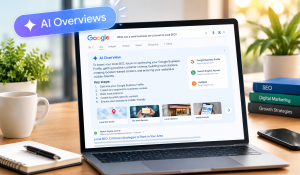
For some queries, Google’s search results may include Google AI Overviews, which are summaries produced by artificial intelligence. Instead of forcing users to visit numerous websites and read many pages to comprehend a subject, Google can provide a condensed response straight in the search results.
Consider a user searching for something like: “What can a small business do to boost its local SEO? “
Google often displays blog entries, tutorials, videos, and commercial websites. The user would then collect the information themselves after opening a number of results.
Google may offer a condensed explanation and links to websites that expand on or support the information with an AI Overview.
This modifies the search process.
Before clicking on any website, the user can get an answer.
This is one of the main reasons that companies are focusing on Google AI Overviews SEO.
Nevertheless, websites may still profit since AI-generated responses may contain connections to sources. A website’s visibility can be drastically different if it is one of those sources.
What is Google’s AI mode?
The AI Mode elevates the search experience that is driven by AI. AI Mode aims to facilitate more sophisticated and conversational searches rather than viewing search as a straightforward question-and-answer exchange. Without having to perform a whole new search each time, users may ask lengthier questions, ask follow-up questions, delve into many facets of a topic, and carry on the discussion.
For example, instead of searching: “Small Business’s Greatest Digital Marketing Strategy”
A user might inquire, for instance: “I’m a modest clothing firm on a tight budget. Is it better to prioritize Instagram, Google Ads, or SEO? “
The second question has additional context. By understanding the question’s purpose, AI-powered search may offer a more tailored response. This implies that SEO specialists must prioritize understanding search intent more than ever before. The only goal is no longer ranking for a particular keyword. People’s genuine issues must be addressed by your content.
What Is the Significance of Google AI Overviews SEO?
Marketers face a new question with the growth of AI-powered search: Why would consumers come to my website if Google can answer the question straight away? This is a legitimate worry.
Users may find that they don’t have to click as many times in certain searches since Google’s search results give them all the information they need. However, this does not imply that websites are no longer useful.
Original material, thorough explanations, goods, services, opinions, comparisons, and reliable sources are still necessary. In many situations, AI-generated answers can expose consumers to websites they might not have found otherwise. Because of this, SEO with Google AI Overviews is less about getting a typical ranking and more about becoming a dependable and understandable source for search engines.
The goal is no longer solely: “How can I achieve the top rank? “
A better question to ask is: “How can I become one of the top resources on this subject? ” That change in mentality is really significant. SEO, in its classic form, is here to stay. The notion that conventional SEO is no longer important is one of the most significant misconceptions around AI search. It does.
Google continues to rely on high-quality content and reputable websites in order to comprehend subjects, products, organizations, and information.
Traditional SEO Is Not Going Away
Although SEO basics are still essential:
- Original and helpful information
- Intent to search
- Keywords of relevance
- Strong web design
- Internal Linking
- High-quality backlinks
- technical search engine optimization
- Experience on the website
- Usability on the go
- Clear titles
- Information arranged in a structured manner.
- Credibility of the Author
- Reliability
The only distinction is that these fundamentals must now support a wider search strategy.
Instead of a replacement for SEO, consider Google AI Overviews SEO to be an extension of it.
AI search is unlikely to magically resolve those issues if your website has poor content, poor technical performance, confusing navigation, and little validity.
Concentrate on the search intent rather than just keywords.
While keywords are still useful, marketers need to know why someone is searching to succeed with modern SEO.
Consider the key word: “digital marketing. ” This word is very inclusive.
The individual searching might be looking for:
- A definition
- A course
- an occupation
- A company that specializes in internet marketing
- Tips for Your Career
- information regarding income
- Approaches to marketing
- Instruments
- Instructions
A successful Google AI Overviews SEO plan begins with knowing what these various objectives are.
A website may create content with a specific focus that addresses certain questions rather than developing a single, general post about “digital marketing. “
As an illustration:
- What is digital marketing?
- How does digital advertising operate?
- How can digital marketing benefit small businesses?
- Is digital marketing a viable career option for 2026?
- How much does digital marketing cost?
- For local businesses, what are the top digital marketing approaches?
Search engines learn more about your experience from this kind of content.
Produce questions That Truly Responds to Inquiries
AI-driven search is really helpful for conversational inquiries.
Instead of using brief terms, people are looking with entire queries more and more.
For illustration: “Without spending money, how can I raise the rating of my website? ”
A low-quality article may use the term “enhance website ranking” several times.
A stronger essay would address the question directly
This might explain:
- How to enhance on-page SEO
- How to address technical SEO issues
- How to Make Your Internal Links Better
- How to Develop Helpful Content
- How to earn backlinks
- Optimizing Your Google Business Profile
- how to evaluate outcomes
This kind of approach supports SEO for Google AI Overviews. Write for real people first, not just for algorithms.
Make Your Content Easy to Understand
Before AI systems can use your material as a possible source, they must first comprehend it. Because of this, content clarity is crucial. Don’t hide your most important response inside of lengthy paragraphs.
Use:
Headings that are obvious.
Divide your information into rational sections.
Short paragraphs
Users find it challenging to scan extensive text portions.
Listings
Whenever bullet points and numbered lists improve the clarity of information, utilize them.
Direct responses
Offer the solution early, then go into further detail, when responding to a question.
An instance would be:
What exactly is technical SEO?
Optimizing a website’s technical components to allow search engines to crawl, understand, and index the site efficiently is known as technical SEO.
Then go on to provide a more thorough explanation.
This framework benefits readers and simplifies the topic’s interpretation by search engines.
Establish Topical Authority
Rarely does one post create a high level of expertise. Make a collection of linked material around your major topic if you want your website to become a reputable source. A website dedicated to digital marketing may, for instance, discuss:
- Search engine optimization
- SEO regionally
- Ads by Google
- Marketing for social media
- Marketing of content
- Marketing via email
- Analytics
- SEO technicalities
- Researching keywords
- Building links
Instead of releasing disconnected articles every week, make related material. This is known as topical authority.
A thorough SEO guide, complemented by more compact articles like these, might comprise a strong content cluster:
- What exactly is keyword research?
- How to conduct keyword research
- What are keywords that are long-tail?
- What is Technical SEO?
- How does internal linking function?
- What are backlinks?
- What’s the best way to increase page speed?
These pages may be linked internally to aid consumers in navigating relevant issues.
This is a key component of a long-term Google AI Overview SEO strategy.
You may strengthen your material by having more prior experience
A significant difficulty with AI-generated content is that the web is becoming overpopulated with redundant material. The same fundamental explanation of SEO may be found on thousands of different websites.
What distinguishes your content, then? Experience.
Instead of just repeating information that is commonly available, tell us:
- Your observations
- Concrete illustrations
- Case studies.
- Screenshots
- Detailed procedures
- Mistakes you’ve come across
- Learned Lessons
- Original research
- Professional judgment
For example, instead of stating: “Monitoring your website is made easier with Google Search Console. ”
You might describe how you utilized Search Console to locate indexing problems, which pages were impacted, the adjustments you implemented, and the subsequent results.
This gives information that typical AI-generated material cannot readily duplicate.
Your content may be more valuable and reliable as a result of this kind of firsthand experience.
E-E-A-T Is More Crucial Now Than Ever
E-E-A-T, according to Google, is an abbreviation for:
Trustworthiness, Expertise, Authoritativeness, and Experience.
It’s especially important while producing material that is designed to rank well in search engines.
Ask yourself:
- Who is the author of this piece?
- Is the writer knowledgeable on the topic?
- Is there any proof of prior experience?
- Are the claims backed up by reputable sources?
- Can readers have faith in the data?
- Is the website clear about who is in charge?
Trust may be enhanced by providing a bio of the author, reliable references, firm data, contact information, and fresh thoughts.
Because AI-powered search requires dependable information sources, credibility is extremely valuable for Google AI Overviews SEO.
Do Not Neglect Technical SEO
Simply having excellent content is not sufficient.
A solid technical basis is also necessary for a website.
Major areas of focus are:
- Crawlability
- Ability to be Indexed
- Page speed
- Mobile responsiveness
- HTTPS
- Canonical Uniform Resource Locators
- XML site map
- links between themselves
- Data with structure
- Web Vitals Core
- Clear URL structure
Imagine writing an excellent piece that Google cannot index or crawl effectively.
The writing quality won’t be that important.
Technical SEO is still crucial for Google AI Overviews SEO for this reason.
Search engines may better grasp your content with the use of structured data.
Search engines receive additional information regarding the content of a website via structured data.
Businesses can use appropriate schema types based on the page, such as:
- Artikel
- Organization
- Local Enterprise
- examine
- FAQ
- Breadcrumb
Your page’s Structured data does not ensure an appearance in an AI Overview.
But when done properly, it may assist search engines in gaining a deeper understanding of the entities and information linked to a page.
Consequently, it should be seen as a component of a larger SEO plan rather than a quick way to gain AI exposure.
The Importance of Inner Links
Internal links are frequently disregarded. Imagine you publish a piece on Google AI Overviews SEO.
Within that essay, you might naturally connect to relevant content about:
- Keyword research
- SEO technology
- Strategy for content
- Regional SEO
- Aim of search
- SEO on-site
This establishes connections between your sites.
In addition, it assists tourists in finding out more.
Both humans and search engines can navigate a website more easily with a solid internal linking framework.
What about click-through rates?
An important SEO measurement issue is presented by AI-powered search.
Marketers have historically placed a premium on metrics like:
- Ratings
- Impressions
- Click
- CTR
- Natural traffic
These indicators continue to be significant.
However, firms may need to consider wider exposure more and more.
Even if your content doesn’t receive the same kind of conventional position-one ranking, it could be referenced or mentioned in an AI-generated answer.
This implies that SEO reporting might need to gradually consider how frequently a business appears in many search results.
Raw clicks may be supplanted by brand visibility, mentions, conversions, and qualified traffic in terms of importance.
Prioritize your audience over AI overviews.
One error companies should avoid making is generating material with the express purpose of influencing results produced by AI.
There isn’t a miraculous recipe along the lines of:
“Google will include you in an AI Overview if you use precisely this amount of keywords. ”
SEO does not operate in such a manner.
Instead, put your attention on creating content that is genuinely beneficial.
Ask:
If Google did not exist, would this essay still be worthwhile?
You’re probably heading in the right path if the answer is yes.
Good content should assist the reader in completing a task, making a decision, comprehending a topic, or resolving a problem.
Sustainable Google AI Overviews SEO is based on that tenet.
How Companies May Get Ready for AI Search
It is not necessary for businesses to immediately overhaul their SEO strategy.
Rather, they can progressively enhance their current technique.
1. Existing Content Should Be Audited
Determine which sites get traffic and which don’t.
Delete unnecessary material and update obsolete data.
2. Pinpoint Vital Inquiries
Find out what questions your audience is asking by looking at competitor research, forums, keyword research, Google Search Console data, and customer discussions.
3. Generate All-Inclusive Responses
When your audience needs a thorough explanation, avoid answering a question with two sentences.
Adequately address the subject.
4. Improve Content Organization
If applicable, employ explanatory headings, brief paragraphs, lists, tables, examples, and FAQs.
5. Include personal experience.
Provide examples, case studies, screenshots, and practical information.
6. Improve Internal Links
Link related articles and crucial commercial pages.
7. Enhance technical SEO
Ensure that crucial pages are easily accessible, indexable, and crawled.
8. Establish Authority
Acquire applicable mentions and backlinks from reputable sources.
9. Enhance Your Brand
An established and dependable brand may grow in worth in a search environment powered by artificial intelligence.
10. Keep an eye on more than just standings.
Observe organic traffic, conversions, impressions, branded searches, engagement, and other important indicators of visibility.
Is AI responsible for the demise of SEO?
No. SEO is evolving. Many times before, the same thing has occurred.
Marketers were concerned that consumers would cease clicking once highlighted snippets were made available.
Businesses questioned if traditional search optimization would become obsolete once voice search gained traction.
Websites were forced to change once again when mobile search took over.
Another significant change is AI
Even if SEO tactics have changed, its goal is the same: to aid users in finding reliable and trustworthy information through search. What’s changing is how search engines offer that information. As a result, the better method is to not give up on SEO. It must be changed.
The Future of SEO with Google AI Overviews
Conversational, personalized, and AI-assisted searches will probably be more common in the future.
Longer inquiries may be made. Search engines should, in their opinion, comprehend context. Without going back to a conventional results page, they can navigate between questions. This implies that businesses’ content strategies must become more thorough. Instead than merely aiming for keywords, a website should do more.
It must demonstrate expertise.
Questions need to be answered.
It must offer genuine value.
It ought to create confidence.
It also needs to make it simple for both people and search engines to understand the company’s activities.
Google AI Overviews SEO’s true potential lies in this.
Last Thoughts
AI Mode and Google AI Overviews are significant advances in how people find information online.
They may alter the way that users engage with search results, but they don’t render SEO useless.
Instead, they guide SEO toward a more advanced approach.
Websites that offer information that is straightforward, precise, unique, valuable, and reliable will be successful in the future.
Companies ought to prioritize becoming helpful sources of information over merely concentrating on ranking for particular keywords. You are laying a solid basis for the evolving search landscape if your information genuinely answers users’ questions, shows genuine expertise, offers beneficial experiences, and is hosted on a website that is technically sound.
SEO for Google AI Overviews isn’t about using a loophole to get into Google’s AI results. It’s about ensuring your website is worthwhile enough to be seen no matter where search is going in the future.
As AI-driven search becomes a more common aspect of regular search behavior, companies that adjust early, understand search intent, invest in high-quality content, increase their authority, and keep enhancing their websites will be in a far stronger position.
SEO isn’t going away.
Businesses must keep up with the changing SEO landscape.