AI is expected to be among the most influential drivers of digital marketing in 2026. Over the years, since the advent of chatbots and automation, the involvement of AI has evolved into an indispensable part of everything in search, advertising, content, analytics, social, experience, and commerce.
The implications to marketers are equally significant. The role of marketers is now becoming more strategic, creative, customer facing, analytical, and responsible for managing AI.
Below are key implications AI is having in digital marketing in 2026.
1. How AI in Digital Marketing Is Transforming Search and SEO

One of the most obvious ways AI is shaping marketing is through search.
People are increasingly asking detailed questions and seeking long-form answers using conversational queries rather than just short keywords. Google is also bringing in more AI experiences in Search with AI Mode and new capabilities, including its announcement in May 2026 to introduce more advanced model capabilities and agentic functionality into Search.
For SEO, it means that marketers will have to increasingly consider search intent and how they can provide what they need;
While traditional SEO elements such as keyword research, technical SEO, internal linking, headings and page experience continue to be important, there is now also a need to produce content that meets what users need. For example, for a page targeting the term digital marketing course, it is necessary to give a comprehensive overview of what the course includes, how it can be of benefit, the underlying skills needed, the tools and techniques taught, outcomes, and anything else relevant.
The aim is to provide content that is genuinely useful to a user, and also easy to find and understand by search engines and AI experiences.
2. AI Agents Are Becoming More Capable
AI agents are another big trend in 2026.
An AI agent is different to a chatbot as it has the ability to pursue a goal, including finding and analyzing information and using different tools – with varying degrees of human input.
This can have a big impact on how customers research and buy products and services.
For instance, a consumer may wish to seek help from an AI agent in the process of looking for, comparing and selecting the most suitable product/service.
This implies that organizations must make sure that the information on their websites is accurate, structured and formatted in such a way that an AI agent can be able to understand it.
For example, product descriptions, prices, availability, contacts, terms and conditions, reviews etc should be presented clearly to be understood by AI agents.
3. Agentic Commerce Is Becoming a Reality
Commerce, including online shopping, is also seeing the arrival of agentic commerce.
In January 2026, Google announced the Universal Commerce Protocol (UCP), an open standard to enable AI agents to engage across the entire purchase lifecycle, from discovery and purchase to post-purchase. Google has also announced Business Agent capabilities, and new tools and features designed around agentic shopping.
This means customers may increasingly use AI agents to find, compare and purchase products and services.
Businesses therefore need to make sure that their product information is accurate and easy to understand by both humans and AI.
Accurate product descriptions, pricing, availability, promotions, specifications, delivery and other information will become even more important in an era of agentic commerce.
4. AI Is Reshaping Content Creation
Content marketing has already been transformed by generative AI.
Marketers can use AI to think up content ideas, headlines, outlines, summaries, social media posts, research, and much more.
This will make creating your content much easier, and get rid of some repetitive tasks.
But, creating a ton of generic AI content isn’t going to provide much value.
With greater use of similar tools by businesses, there is an even greater importance on creating content that provides genuine value to the reader.
Content should include useful information that can help people, for example, by including specific advice, examples, customer insights and other information.
AI can help to create content, but marketers should take responsibility for ensuring the accuracy, quality and value of the content.
Google has also stated that its Search algorithms prioritize helpful content, and that the helpfulness of a page is not determined by whether it was created using AI or not.
5. Human Expertise Is Becoming More Valuable
With the rise of AI, human expertise and the value of experience is becoming more important.
While information can be readily generated by AI, human experience and knowledge provides much greater insight.
For example, a digital marketing expert can provide more value to a client by discussing and sharing lessons learnt from previous digital marketing campaigns and experience working with real customers.
Human expertise can be extremely valuable in ascertaining the accuracy of information produced by AI.
This is particularly important given the frequency with which generative AI provides incorrect information, and marketers should therefore verify any critical information before sharing it.
6. Advertising Is Becoming More AI-Driven
In 2026, digital advertising is undergoing an overhaul fueled by artificial intelligence.
Google has been rolling out AI ad capabilities across its advertising products, including Search, Shopping, measurement, and campaign management. Google Marketing Live 2026 announced the launch of ads in AI Mode, AI Max for Search and Shopping, AI powered Shopping Ads, AI Brief, Business Agent for Leads and demand led budget pacing.
AI powered Shopping Ads, for example, can utilize Gemini to provide tailored product descriptions based on a customers search query.
Google is also bringing more AI assisted advertising features, such as Ads Advisor which can help with campaign management, recommendations, troubleshooting and policy related queries, and new agentic safety features that make account management even more automated.
These advertising developments can help to reduce the amount of time spent on repetitive and manual campaign management tasks.
However, human expertise is still required to make decisions around a business’ advertising strategy, messaging, audiences, and budgets.
7. Personalization and First-Party Data Are Becoming More Important

Customers increasingly expect to be able to receive relevant recommendations, rather than generic marketing messages.
AI enables businesses to analyze customer behavior data to provide more personalization at scale.
For example, an online store can utilize browsing and purchase data to recommend products that may be of interest to a customer.
Email marketing can also be more effective through personalization and segmenting an email list.
First-party data, including website analytics, CRM data, customer service, sales, forms and general customer interaction data, is also particularly important as businesses have direct access to the information and can utilize it to improve marketing and operations.
AI can be used to analyze this wealth of first party data, and highlight trends and opportunities.
However, marketers should ensure that they are interpreting the data correctly, and utilizing it in an appropriate manner.
8. Social Media and Customer Experience Are Evolving
AI is increasingly being utilized across social media marketing.
Marketers can utilize AI to come up with social media ideas, create caption drafts, analyze trends and conversations, report and summarize insights, and much more.
This can help to reduce the amount of repetitive social media management tasks, and help to drive greater focus on strategy and engagement.
Similarly, customer experience is also being transformed by the rise of AI.
Chatbots and virtual assistants are being used to answer customers’ questions and handle their requests.
This can allow firms to respond to a customer’s question quickly and also scale customer service.
Nevertheless, firms should not overly rely on an automated system and should make sure that humans are also available, for example, for more complicated complaints.
9. Marketing Analytics Is Becoming More Intelligent
Digital marketing analytics consists of a huge amount of data.
Marketers need to be able to understand traffic, conversions, audiences, customer behavior, sales, and much more in order to make informed marketing decisions.
AI can make sense of marketing data and find trends and opportunities that otherwise might be missed.
For example, a marketer may see that website traffic has increased, but that there has been little change in overall conversions. An AI assisted analysis can help to find potential reasons for this, for example, if there has been an increase in low quality traffic, or if there are issues with the landing pages or campaign messaging.
Google is also making it easier to get value from marketing data by connecting marketing tools with AI assistance.
Launched in May 2026, Ask Advisor integrates information from Google Ads, Analytics and Merchant Center to offer personalized advice and enable marketers to leverage the benefits of their data.
Prediction models will also be useful for forecasting possible trends and patterns in the future.
But it is worth noting that predictive models are mere estimations, and marketers must take into account factors such as competitors’ activities and the economic environment of the future.
10. Marketers Need New Skills in 2026
The evolving nature of marketing requires marketers to be multi-skilled.
Core skills such as SEO, advertising, analytics, customer behavior, communication, social media marketing, and strategic thinking will continue to be crucial.
In addition, knowledge of AI, prompt engineering, information analysis and fact checking, and using AI to solve marketing problems are increasingly important.
Critical thinking skills will be required to ensure that information generated by AI is accurate and fits the specific need.
Understanding how to use AI to generate content is only one part of content marketing. Critical thinking, fact checking and ensuring the content is engaging and fits the intended audience is also required.
11. Ethical and Responsible AI Use Matters
With the increased use of AI across marketing, ethical and responsible use is becoming increasingly important.
In this regard, marketers handle customers’ data, advertising data, and personalization. It is, therefore, extremely important that they maintain confidentiality, transparency, and accuracy. Marketers should always ensure that their use of AI conforms to all these requirements.
Marketing teams should come up with responsible AI principles. This is especially true for customer-facing content and advertising, and other critical tasks.
AI can help marketing teams but human responsibility should never be neglected.
How Marketers Can Prepare for the AI-Driven Future
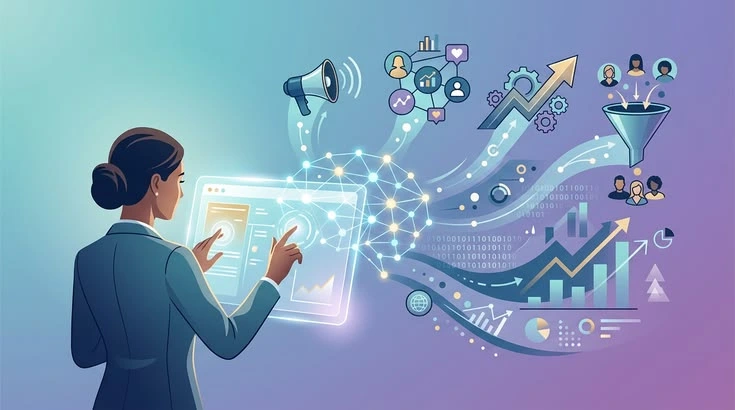
Marketers do not need to make use of each diverse form of AI tools. A more realistic approach would be to focus on particular use cases of AI and establish how AI could benefit and support certain marketing activities.
For instance, a marketing team could begin using AI for repetitive tasks such as research, reporting, brainstorming, data analysis, content outlines and customer support. Once they are accustomed to the use of AI tools, they could then look into more sophisticated applications of AI in marketing.
The key thing is that marketers need to develop their core skills such as SEO, advertising, analytics, email marketing, content marketing and social media marketing as well.
AI can assist with all these different marketing activities, but it should help and augment core skills, rather than replace them.
Final Thoughts
The rise of AI is impacting almost every aspect of modern marketing. Search is evolving, and includes more conversational and agentic features. Advertising platforms are becoming more automated and AI driven. AI agents are being utilized in commerce. Content creation is becoming faster, while human knowledge and expertise is becoming more valued. Data, personalization, and analytics are also gaining greater importance.
The developments in 2026 are an indication of the future of marketing – where AI is used to research, analyze, create, optimize, and even take actions in marketing. Google’s 2026 announcements about AI Mode, AI powered ads, AI Max, Ads Advisor, Ask Advisor, and agentic commerce demonstrate how rapidly AI capabilities in marketing are evolving.
The future of marketing therefore does not just involve using more AI, but a thoughtful and strategic approach to using AI to support marketing, while maintaining core skills and competencies, accurate information, customer insights, and responsible marketing.